A Parent’s Guide to Basketball Club Teams in San Diego
San Diego has no shortage of basketball options for kids, and that is both the good news and the problem. Parents looking at club basketball for the first time often assume the hard part is getting their child selected. In practice, the harder task is choosing the right environment once the invitations start rolling in.
Club basketball can be a strong place for player development. It can also become an expensive carousel of uniforms, weekend tournaments, and promises that sound impressive but do not hold up over time. Families new to the scene usually find themselves asking the same questions. How competitive should the team be? How much travel is normal? Is more basketball always better? What separates a serious program from one that simply markets itself well?
Those questions matter in San Diego because the club landscape is unusually broad. You have beach communities, large suburban areas, strong public and private school pipelines, and year-round basketball opportunities that many colder regions simply do not have. That creates choice, but it also creates noise. A parent who understands how Basketball Club Teams San Diego actually operate will make better decisions, save money, and often keep the game fun for their child longer.
What club basketball really is, and what it is not
Club basketball sits in a space between recreational leagues and school teams. It is usually more competitive than rec, more specialized in skill development, and more demanding on family schedules. Unlike school basketball, club teams are not tied to a campus identity, district boundary, or academic calendar. That flexibility is part of the appeal. Players can seek stronger competition, more exposure, or a better developmental fit.
Still, club basketball is not a magic shortcut. It does not automatically lead to varsity minutes, college recruiting, or better fundamentals. I have seen players improve dramatically in club settings because they found a coach who taught footwork, spacing, and decision-making with real discipline. I have also seen talented kids plateau because their team played four games every weekend and practiced very little with purpose.
That is the first mental shift for parents. A club team is not just a brand name or a tournament schedule. It is a learning environment. If the environment is poor, the logo on the jersey will not rescue it.
Why San Diego is its own kind of market
San Diego basketball has a few traits that shape the club experience. The first is geography. A family in Carlsbad, Chula Vista, Eastlake, La Mesa, Poway, and downtown San Diego may all say they live in San Diego, but weekly logistics can look completely different. Traffic alone can turn a two-hour practice commitment into a four-hour family disruption.
The second trait is year-round play. Because weather rarely shuts gyms down for long stretches, many programs run nearly nonstop. That can be great for highly motivated athletes, but it also creates burnout risk. A 12-year-old does not always need a spring season, summer season, fall league, private training, and shooting sessions layered on top.
The third is competition density. Southern California basketball generally offers more tournaments and more talent than many other regions. That means strong players can find quality games without flying across the country every month. It also means some organizations oversell travel and exposure, even when equally useful competition is available within driving distance.
Parents should view all of this through a practical lens. A San Diego club team that is close to home, practices with structure, and enters solid local or regional events may be far better for your child than a flashier team with constant travel and less teaching.
The age question parents wrestle with
One of the most common mistakes is moving into club basketball too early, or entering for the wrong reason. Families sometimes worry that if their child is not on a club team by fourth or fifth grade, they will fall behind forever. That fear is powerful, and coaches know it.
The truth is more nuanced. Some younger players thrive in a club setting because they are hungry to learn, enjoy competition, and still have room for other sports and downtime. Others are better served by rec leagues, local clinics, and backyard reps until they are older and more physically and emotionally ready for the intensity of travel ball.
For elementary and early middle school players, the best indicator is not raw talent. It is whether the child loves the process enough to handle the demands. Does your son or daughter want extra practices, or are you the one pushing? Does competition energize them, or leave them discouraged for days? Are they coachable when things go badly?
At younger ages, fit matters more than status. A player getting meaningful instruction and touches on a solid local team often develops faster than one buried on the bench of a name-brand program.
What a healthy club program looks like
Strong clubs tend to be less theatrical than weak ones. They usually do not promise outcomes they cannot control. Instead, they focus on things that are measurable. Practice quality. Skill progression. Consistent communication. Realistic scheduling. Honest feedback.
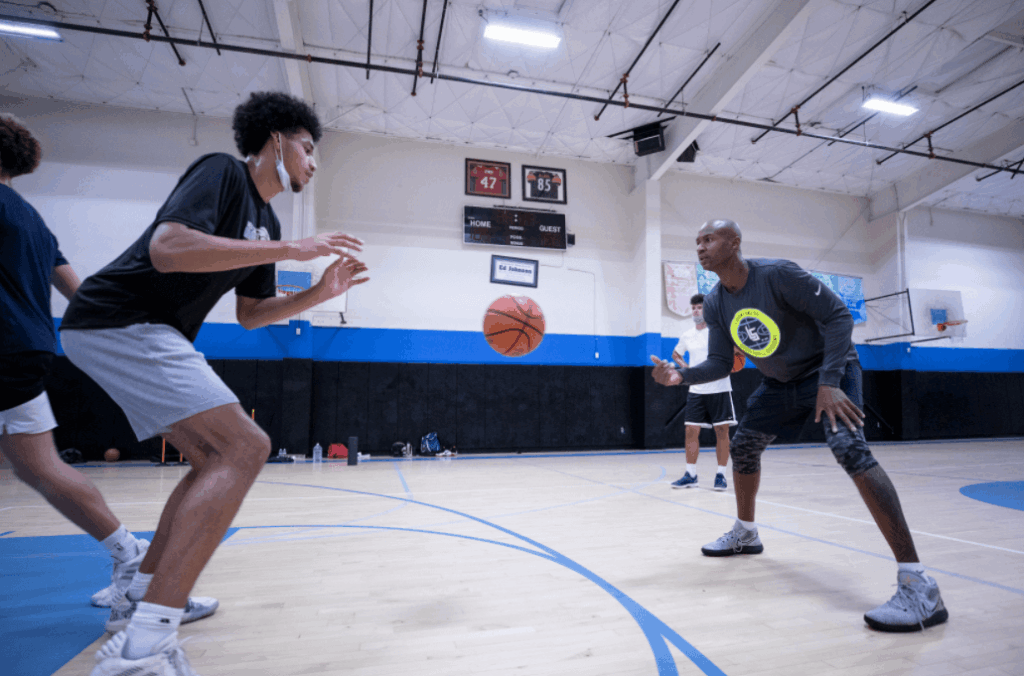
You can usually tell within one or two gym visits whether a staff teaches or merely supervises. In a teaching environment, coaches stop action to fix details. They correct stance, timing, defensive angles, passing windows, and decision-making. They know why a drill exists. Practices have pace, but not chaos.
In a weaker environment, practice often becomes a string of generic drills followed by long stretches of scrimmaging. Players may sweat a lot without actually learning much. Parents sometimes mistake volume for development. More games, more practices, and more social media clips do not necessarily equal better basketball.
A healthy program also has age-appropriate expectations. It does not demand college-level specialization from a 10-year-old. It does not use fear to control playing time. It does not treat every family concern as disloyalty.
The money side, without the sales pitch
Club basketball in San Diego can range from moderately expensive to very expensive. Costs vary based on the level of competition, gym access, coaching pay, tournament volume, uniforms, and travel model. There is no single standard fee structure, which is why parents need to ask detailed questions before committing.
Some teams quote a season fee that sounds manageable until add-ons start appearing. Uniform packages, tournament admissions, extra training sessions, travel hotel blocks, and administrative fees can shift the true number quickly. A family that thinks they are joining for a few thousand dollars may find the real seasonal cost significantly higher.
Price alone does not tell you whether a program is worthwhile. A lower-cost team that rents inconsistent gym space and barely practices may not be a bargain. A higher-cost team with excellent coaching and transparent operations may be worth it. The key is clarity. You want to know what the money buys.
A useful rule of thumb is to compare cost against actual player experience. How many practices per week? How long are they? Who is coaching them? What tournaments are included? How stable is the roster? If a team charges premium rates but cannot answer those questions cleanly, pause before signing anything.
Playing time, development, and the truth parents need early
Few issues create more tension than playing time. Parents often assume club basketball should be developmental because the players are still young. Coaches often treat tournaments as competitive events where minutes are earned, not distributed equally. Both perspectives can be valid, but problems start when expectations are vague.
Before joining, find out whether the team has a formal playing-time policy. Some younger age groups are closer to equal-development models. Older and higher-level teams usually shift toward role-based minutes. Neither approach is automatically right or wrong. The mistake is joining a team under one assumption and discovering a different reality in the second weekend of the season.
Parents should also separate game minutes from actual development. A child can play a lot on a weak roster and improve very little. Another child may have a smaller role on a stronger team but receive better coaching and sharper daily competition. The right choice depends on temperament, age, and current skill level.
That said, chronic bench time is rarely good for a young player, especially if the coaching communication is poor. If your child consistently plays one or two minutes per game and cannot explain what they need to improve, the environment may not be serving them.
The recruiting myth starts early
San Diego parents hear the word “exposure” far too early. For middle school players especially, exposure is usually not the central issue. Development is. A player who can truly play will have chances later if they continue improving.
Some clubs market themselves as pathways to college recruitment, and for certain older age groups that can matter. But no honest coach should sell a sixth grader on scholarship visibility. At that stage, the focus should be skill development, confidence, game understanding, and physical growth. The most recruitable traits later on often come from boring, https://deanwhyv700.quantlynix.com/posts/san-diego-basketball-club-teams-creating-stronger-community-bonds disciplined work done years before the recruiting conversation becomes relevant.
Even in high school, exposure is only useful if the player is ready for it. College coaches are not just collecting mixtapes. They watch body language, defensive habits, pace, communication, and whether a player impacts winning. A weekend in front of dozens of coaches does little if the athlete cannot execute.
Parents are better off asking a simpler question. Is this team helping my child become the kind of player coaches notice for the right reasons?
How to evaluate coaches without getting distracted by branding
A coach’s résumé matters, but less than many parents think. A former college player can be excellent, average, or poor as a youth coach. A coach without a flashy playing background can be exceptional if they teach clearly, organize well, and connect with kids.
Watch for the details. Does the coach know every player’s name? Do corrections sound specific or generic? Are mistakes used as teaching opportunities, or as public shaming moments? Is the coach able to challenge players without humiliating them?
The best youth coaches usually have a mix of technical knowledge and emotional control. They understand that children develop unevenly. The kid who looks dominant at 11 may be average at 15. The player who struggles physically in seventh grade may blossom by sophomore year. Coaches who understand that arc tend to teach more patiently and evaluate more honestly.
A brief anecdote illustrates the point. I once watched two 13U teams in back-to-back games at a local event. One coach yelled constantly, called every set from the sideline, and blamed players after each turnover. His team was talented and tense. The next team had less obvious talent, but their coach taught spacing during timeouts in calm, direct language. Players made mistakes, adjusted, and kept competing. By season’s end, the second group had improved far more. The difference was not motivation. It was coaching.
The schedule has to work for the whole family
Parents sometimes underestimate how much club basketball affects siblings, work schedules, and home life. This is especially true in San Diego, where practices may be spread across multiple gyms and tournaments can mean long driving days across the county or beyond.
A team that practices three nights per week in a distant location may be manageable for one household and impossible for another. The best basketball opportunity on paper is still the wrong fit if getting there creates weekly strain that the family cannot sustain.
Be honest about bandwidth. Some families enjoy the travel rhythm and gym culture. Others quickly feel swallowed by it. Neither response is wrong. The point is to choose with clear eyes. A slightly less prestigious team with a sane schedule often produces a better season than a constant scramble toward someone else’s idea of elite basketball.
Questions worth asking before you commit
A short conversation with a director or coach can reveal a lot if the questions are direct.
- How many practices and tournaments are included in the season fee?
- Who coaches practices and games, and does that stay consistent?
- What is the team’s approach to playing time and player roles?
- How stable is the roster, and how often are players added or moved?
- What does the program believe matters most at this age, development, exposure, or winning?
Notice not just the answers, but the tone. Clear, straightforward answers usually signal organizational health. Defensive or slippery answers usually signal future frustration.
Warning signs parents should not ignore
Most families learn these the hard way at least once. It is better if you do not.
- Constant promises about scholarships or guaranteed advancement
- Frequent surprise fees or vague cost explanations
- Coaches who scream more than they teach
- Roster sizes so large that meaningful minutes become unrealistic
- Last-minute schedule chaos as a normal pattern, not an exception
One red flag by itself may not be fatal. Life happens, gyms change, and youth sports can be messy. But when several of these show up together, the pattern usually tells the truth.
School basketball and club basketball should not be pulling in opposite directions
For middle school and high school players, the relationship between school ball and club ball matters. The best scenario is complementary development. Club basketball can sharpen skills and expose players to different competition, while school basketball builds local chemistry, school pride, and role clarity within a season that matters deeply to the athlete’s community.
Trouble starts when one environment undercuts the other. A club coach may imply that school basketball is secondary. A school coach may distrust club habits or resent outside influence. Players can get stuck in the middle.
Parents should stay balanced here. Unless a situation is clearly unhealthy, it usually helps to respect both spaces. Let school coaches coach school ball. Let club coaches handle club season. If your child hears contradictory instructions, focus on principles that travel well anywhere, effort, spacing, defense, communication, and decision-making under pressure.
When it is time to switch teams, or step away for a while
Not every club experience needs to become a long-term relationship. Sometimes a player simply outgrows the team. Sometimes the fit was wrong from the start. Sometimes a family realizes the current level of commitment is too much for this season of life.
Switching teams is reasonable when the move is driven by substance, not emotion after one bad weekend. Look for recurring patterns. Is your child no longer improving? Has communication broken down? Are practices disorganized month after month? Is the environment damaging confidence rather than building resilience?
Stepping away can also be healthy. Kids do not always need more competition. Some need time to rebuild joy in the game, work on fundamentals in smaller settings, or play another sport for a season. Rest is not failure. For some players, it is exactly what allows them to return sharper and more motivated later.
The parent role that actually helps
Parents have less control over outcomes than they think, but more influence over the experience than they realize. The most helpful parents usually do three things well. They choose carefully, they communicate calmly, and they keep the game in perspective.
After games, resist the urge to conduct a ride-home breakdown. Most kids either know what went wrong or need a little space before talking. A simple “I loved watching you compete” often goes farther than ten minutes of technical analysis. If your child wants feedback, keep it grounded. One or two observations are enough.
It also helps to remember that development is rarely linear. Players surge, stall, lose confidence, grow physically, get hurt, and then put it together months later. Club basketball can make every weekend feel high stakes. For young athletes, it usually is not. What matters most over time is whether they are learning, staying healthy, and still wanting to come back to the gym.
Finding the right fit in the San Diego basketball scene
The best Basketball Club Teams San Diego families choose are not always the ones with the loudest reputation. Often, they are the teams where expectations are clear, practices are meaningful, coaches are steady, and the child feels challenged without being crushed.
That fit will look different for every family. One player needs top-level competition and is ready for a demanding travel schedule. Another needs a strong local team, good teaching, and room to keep soccer or baseball in the mix. One parent values exposure. Another values joy and consistency. Both can make sound choices if they are honest about the child in front of them, rather than the fantasy version of where the sport might lead.
If you keep coming back to one central question, make it this one: is this environment helping my child grow as a player and as a person? When the answer is yes, club basketball can be a terrific part of growing up in San Diego. When the answer is no, no amount of branding, travel, or social media polish will make it worth the cost.
Lamont Smith Basketball Academy
888 Clairemont Mesa Blvd Suite T-2, San Diego, CA 92123
(619) 639-8778
FAQ About Basketball Club Teams San Diego
How can a player join an LSBA club team?
Players are evaluated during practices so the coaching staff can recommend an appropriate team and development level. Families should contact the academy to confirm current openings and evaluation details.
Are club teams available for newer basketball players?
Yes. LSBA describes multiple levels, including a developmental option for newer players as well as more competitive teams for athletes with prior club experience.
What do LSBA club team practices emphasize?
Practices emphasize basketball fundamentals, team defense, structure, communication, and player development. The specific focus may vary according to the team and experience level.
Do all LSBA teams travel?
Travel expectations vary by level. Some teams focus on local competition, while advanced teams may participate in tournaments elsewhere in Southern California or beyond. Families should confirm the current schedule before enrolling.